Honey is one of the world’s most adulterated food products. According to the EU and international control authorities, large volumes of honey are diluted each year with cheap sugar or syrup solutions, often in ways that cannot be detected using traditional analytical methods currently approved by the EU.
For consumers, the product is just as difficult to assess—it looks like honey and tastes fairly similar.
– One might think it doesn’t matter much whether it’s syrup or honey you pour over your yogurt, says Fabian Lindhe, Chairman of Honungsringen, a non-profit association working to increase knowledge and promote greater transparency regarding honey. Its activities are carried out with support from the Swedish Board of Agriculture.
– But you have to consider that honey production is part of a much larger system. Bees and beekeeping are essential for pollination, for example in seed production. When genuine honey is pushed out by cheap syrup, it ultimately risks affecting the entire ecosystem - not just beekeepers, but biodiversity, agriculture, and our food supply.
[PDF]
He points out that problems arise when beekeepers are forced to compete at the same price level with products that have significantly lower production costs, leading to professional beekeepers shutting down across Europe.
– Another important aspect is that fake or heavily processed honey lacks the beneficial properties of real honey. Consumers are essentially deprived of the compounds that make honey unique, says Fabian Lindhe.
– That also raises the question: What is actually in the jar if it’s not honey? It’s not stated on the packaging, and it could be something that is not even beneficial for us to consume. As a consumer, you should have the right to know that.
The large price difference between genuine honey and sugar-based syrup is a key reason why honey fraud is so profitable. The fact that dilution with syrup is difficult to detect using traditional test methods makes the honey sector particularly attractive to criminal actors.
To investigate how widespread this issue is in Sweden, Testfakta commissioned two independent laboratories—Celvia in Estonia and Sinsoma in Austria—to analyze twelve liquid honeys using new, advanced DNA technology.
The method is based on the fact that genuine honey has a characteristic biological profile, containing DNA traces from plants, animals, insects, and microorganisms that naturally follow from the environment through the honey production process. When honey is diluted with syrup or sugar, or heavily processed—for example through heating—the DNA profile changes in a way that can be detected in the laboratory using this new method.
Anita Lipu is one of the test managers at the Estonian research institute Celvia, which is partly owned by the University of Tartu. They have developed the DNA analysis method for honey with support from the EU’s European Agricultural Fund for Rural Development.
– DNA analysis examines the complete biological fingerprint of honey - what plants the bees have visited, which microorganisms are present, traces of bees and other fauna, and in what proportions. Any deviations, such as adulteration or improper handling, alter this fingerprint in a detectable way. The strength of the method lies in the fact that it is practically impossible to manipulate honey without simultaneously altering its DNA profile. While fraudsters have found ways to circumvent traditional methods such as NMR testing, it is nearly impossible to do the same with DNA analysis, says Anita Lipu.
Celvia’s analysis includes between 10 and 20 million DNA sequences in each honey sample, using machine learning to identify deviations from profiles of verified genuine reference honeys. Celvia’s honey database is primarily based on European honey but also includes a significant number of samples from other parts of the world such as South America and Asia. In total, the model is based on more than 1,100 carefully selected samples.
Only five samples were assessed as likely to be genuine
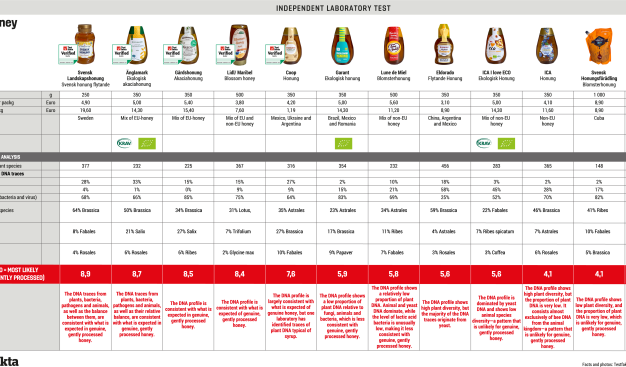
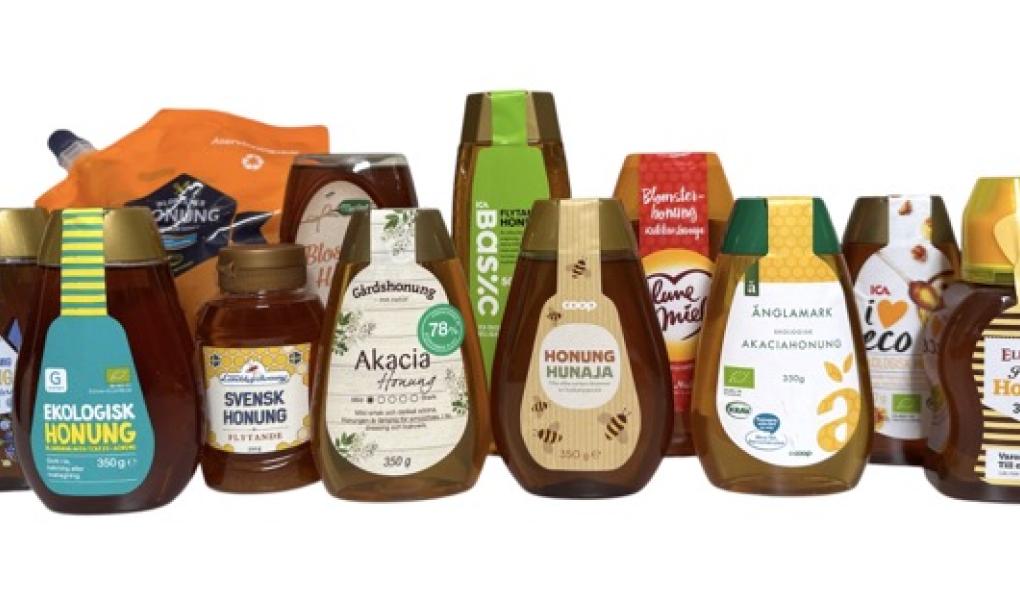
Testfakta analyzed twelve types of liquid honey from Swedish stores. Eleven of the brands were imported honey and one was Swedish. The honeys were rated on a ten-point scale, where 10 indicates most likely genuine and 1 indicates likely not genuine. The tests showed that only five samples passed. The remaining ones showed clear signs of dilution or improper processing.
In seven out of twelve products, the DNA analyses indicate significant deviations inconsistent with genuine honey. ICA’s three honey products all show a low proportion of plant DNA, between 2 and 9%, combined with a high proportion of yeast. Eldorado’s honey shows high plant variation, but the majority of the DNA consists of yeast. Svensk Honungsförädling, Lune de Miel, and Garant also show low levels of plant DNA and profiles inconsistent with genuine honey.
– It is not possible to determine exactly what has been done in these cases, but it is clear that there are strong indications that the honey is not genuine and unadulterated, says Anita Lipu.
– When honey is diluted with syrup, for example, it becomes less stable, allowing yeast and bacteria to grow. That is why we often see significantly higher levels of yeast in honey that we assess as adulterated compared to genuine honey.
The Only Swedish Honey Is Genuine
The only Swedish honey in the test comes from Svensk Landskapshonung, and it is highly likely to be fully genuine.
– It has a high proportion of plant DNA, a wide variety of plant species, and a low level of yeast, and the overall DNA profile matches well with that of genuine honey, says Anita Lipu.
The DNA profiles of Änglamark, Gårdshonung, and Maribel are also consistent with what is expected of genuine honey and therefore pass according to both laboratories.
Coop’s honey scores slightly lower than the top four but is still considered likely to be genuine. It has a high proportion of plant DNA and a clear honey profile, but the Austrian laboratory Sinsoma detected a very small amount of DNA from sugarcane aphids in Coop’s honey, which is typical of syrup. If the bees had been fed syrup during the harvest season - which is not permitted for genuine honey - the DNA profile would show a more pronounced effect. The deviations in Coop’s honey may instead be due to residues from winter feeding with sugar solution, which is allowed.
Genuine Can Become Non-Genuine
Anita Lipu explains that even if honey is initially genuine, heavy processing can alter its DNA profile.
– Ultrafiltration removes pollen grains that contain plant DNA, and excessive heating damages the DNA molecules themselves. Processes that change the water content also affect the microbial balance. Such methods may result in honey no longer being classified as genuine under EU legislation, as they fundamentally alter its composition.
– DNA analysis is a new and effective tool for distinguishing between products that meet the requirements and those that do not, says Anita Lipu. The hope is that better control methods and increased transparency can contribute to a fairer market, where both consumers and serious beekeepers get what they are entitled to.
She advises that the safest choice is to buy honey directly from a local beekeeper.
– If you are unsure, a regional beekeeping association can often provide guidance. When buying in stores, it is important to read the fine print and not rely solely on the front label. Origin is crucial - avoid products labeled as “a blend of EU and non-EU honeys.” The more specific and local the origin, the better. Price is also an important indicator. An extremely low price is often too good to be true. Beekeeping is costly, and reasonable prices are essential for both quality and sustainable production.
All honey samples were purchased during autumn 2025. Unfortunately, Svensk Landskapshonung will not sell any liquid honey in 2026, says Håkan Lantz, Chairman of the board.
– Last year only yielded small harvests in late summer, and that is the harvest used to produce liquid honey for winter sales. Hopefully, the coming summer will offer more suitable weather for late-season honey so we can bring the product back!